

Don’t have time to read now? Listen to the audio version (15 min).
How to Shift Your Energy and Raise Your Vibration When Perimenopause Has You Feeling Low
Something shifts in perimenopause that is hard to put into words at first. It is not just tiredness — you have been tired before, and this is different. It is more like a dimming. A loss of colour in things that used to feel alive. You find yourself going through the motions, smiling when you need to, functioning perfectly well on the outside — and feeling strangely absent on the inside.
Some women describe it as losing themselves. Others call it a fog. Some say they feel like they are watching their own life from a distance, not quite able to reach it.
If any of this resonates — whether you have a perimenopause diagnosis or you are just beginning to wonder whether this might be what is happening to you — then what I am about to share might genuinely help.
It is called working with the Levels of Consciousness, based on the work of Dr David Hawkins. And before I explain what it is, I want to tell you what it actually feels like when you use it — because that is what makes me keep coming back to it.
When I use this practice, the low feeling does not vanish straight away. But something changes. It starts to feel less stuck. Less permanent. Like there is a little bit of air in the room again. You go from feeling completely overwhelmed by what you need to do and how you are feeling — to being able to just sit with it and say: okay, this is where I am right now. And that is enough to start moving again.
I have used it on really dark days. Days when I could not see the point of anything. And it helped — not by making everything suddenly fine, but by giving me just enough ground under my feet to take the next small step.
First — Why Does Perimenopause Affect Your Mood So Deeply?
Before we get into the practice, it helps to understand what is actually happening. During perimenopause, oestrogen levels decline and fluctuate — and oestrogen has a direct effect on serotonin and dopamine, the brain chemicals that regulate mood, motivation, and your sense of wellbeing. So when your hormones shift, your emotional baseline shifts with them. This is real, it is physical, you are not imaging it, and it is not your fault.
But here is something I have noticed — both in myself and in the women I work with. Even when we address the hormonal side, there is often an emotional layer underneath that does not fully shift. Old patterns. Long-held beliefs. A way of seeing ourselves and our lives that keeps us stuck at a particular emotional frequency, regardless of what is happening around us.
That is exactly where this practice comes in.
What Is “Levels of Consciousness Theory”?
Dr David Hawkins was a psychiatrist and researcher who spent decades studying human emotional states and mapping them onto a scale — which he called the Map of Consciousness. His book Power vs Force explains the full framework, and I highly recommend it. But you do not need to read it to use this practice. You just need to understand the map.
The core idea is this: every emotional state we experience has a particular energy level, a particular frequency or vibration if you like. Some emotional states drain us — they suppress life, make everything feel harder, keep us small. Others restore us — they expand life, open things up, make the next step feel possible again.Hawkins assigned a number to each state on a scale from 1 to 1000. Everything below 200 drains your energy. Everything above 200 gives your energy back. The number 200 — Courage — is the crucial turning point. That’s the goal. Not bliss, not enlightenment. Just Courage.
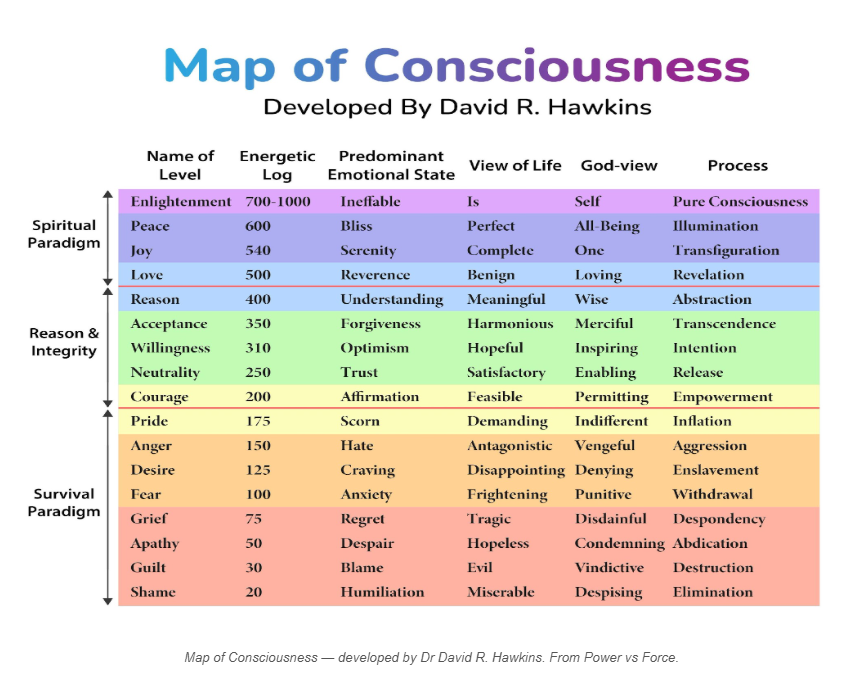
Let me walk you through the key levels so you can see where different emotional states sit — and perhaps recognise where you are right now
⬇ BELOW 200 — Energy draining states
- 20 Shame — The very lowest state. Deep feelings of worthlessness, humiliation, and self-blame.
- 30 Guilt — Self-condemnation and the sense that you are fundamentally flawed or wrong.
- 50 Apathy — Hopelessness and helplessness. Nothing feels worth trying. A heavy, defeated numbness.
- 75 Grief — Deep sadness and loss — for who you were, for what you had, for what might never be.
- 100 Fear — Anxiety, worry, and a constant sense that something threatening is coming.
- 125 Desire — Craving and longing — always wanting something different, always feeling like what you have is not enough.
- 150 Anger — Resentment, frustration, and rage. Feels more energetic than apathy — but still drains.
- 175 Pride — Defensiveness and the need to be right. A fragile ego that cannot afford to be wrong.
⬆ 200 AND ABOVE — Energy giving states
- 200 Courage — The turning point. A willingness to face life, to act, to believe things can change. This is where life-force returns.
- 250 Neutrality — A calm “live and let live” attitude. Things feel less urgent and less catastrophic.
- 310 Willingness — Genuine optimism and positive motivation. A growing trust that things will work out.
- 350 Acceptance — Taking responsibility for your life. Real forgiveness — of yourself and others.
- 400 Reason — Clarity, wisdom, and insight. Seeing things as they really are.
- 500 Love — Unconditional compassion and love — for yourself and others. A sense of wholeness.
- 540 Joy — Deep, quiet serenity and genuine sense of completeness.
- 600+ Peace & Enlightenment — Transcendence and pure presence. Rare — but real.
According to Hawkins, around 85% of people spend most of their lives below 200. And in perimenopause — with the hormonal shifts, the identity upheaval, the emotional weight of everything that surfaces — it is even easier to find yourself in the lower states. Not because you are weak. Because you are genuinely carrying a lot.
The good news is that you do not have to stay there. And you do not have to leap from grief straight to joy (you can’t in fact). You just need to move up one level at a time — starting with wherever you are now.
How to Work With the Levels — The Practice Itself
Here is how I use this in my own life — and how you can start today.
- Identify where you are — honestly. Look at the scale and ask yourself: where am I today? Not where I want to be or where I should be. Where am I right now? Is it grief? Fear? Anger? Apathy? Name it, without judging yourself for being there. Simply naming the state is the first step out of it. (Naming the emotion we feel calms the Amygdala – a threat center of your brain).
- Accept it — do not fight it. This is the most important and most counter-intuitive step. Do not try to fix the feeling or push it away. Do not tell yourself you should not be feeling this. Simply say — out loud or just internally: “I accept that life feels… and I accept that I feel…” Say it once. What we resist persists. What we genuinely accept begins to move. The more we resist the feelings or thoughts we have, the more we feel stuck because it keeps us returning over and over to the same place. It’s called rumination and it is driven by not wanting to feel what we feel. It’s like a jammed computer program, which after receiving a command to “not think about the X” is constantly scanning the environment to identify all the Xs so that it can perform the task of “not thinking about the X” !
- Move up one level at a time — do not skip steps. Look at where you are on the scale and ask: what is the next level up from here? If you are in grief (75), the next level is fear (100) — not joy, not love, not courage. Just one step up. Accept grief first, then move to fear, then anger, then pride — one level at a time, in order. If life feels especially hard, stay at a particular level for up to three days, fully accepting it, before moving upward. There is no rush and no shortcut.
- Your destination is Courage (200) — not bliss. You do not need to reach Love or Peace to feel better. Courage at 200 is the turning point — the first state where energy starts coming back to you instead of draining away. Once you reach Courage — the feeling that life is manageable, that you can take small action, that things can change — you already are in a completely different place. Everything above that becomes more reachable from there.
Look up Hawkins’ full map online — seeing it laid out visually makes it much easier to locate yourself and understand the journey. Understanding the map also helps you stop blaming external circumstances for how you feel, and recognise that your perception — and your consciousness level — can shift when your inner attitude shifts.
My Personal Ritual — Using Water to Help the Process

I want to share something personal here because I think it makes this practice much more real and accessible.
When I am in a low state — when I feel despondent, listless, guilty, or like I have completely lost myself — I use water to deepen the letting go. A shower, a bath, or going into the sea if I am near it. And while I am in the water, I express my acceptance out loud:
“I accept that life is challenging right now. I accept that I feel anger. I accept that I feel grief. And I allow the water to carry away everything that is keeping me stuck at this level.”
You only need to say it once. There is something about water — moving, cleansing, flowing — that makes this practice more powerful both physically and symbolically.
This is not a replacement for professional support, if you are struggling significantly. But as a daily self-practice — a way of consciously working with your own emotional states — it is one of the simplest and most effective tools I know.
The feeling low can come because of hormonal fluctuations or it can be a response to a life event. This practice works well in both scenarios, because at its core, it is about accepting life and not reinforcing the negative feelings by dwelling on them or ruminating about it.
The first 4 years after separating from my ex-husband I had to move home 11 times! And at a certain point I was feeling really low and resentful at life that it keept happening. Life can be hard and we feel unfair at times, but it doesn’t mean you need to, or want to, stay stuck in a low emotional state.
A Final Word on Perimenopause and Your Emotions
One of the things I hear most often from women in perimenopause is that they feel emotionally out of control — their reactions are too big, their lows are too deep, their sensitivity is too much. And the world often confirms this by telling them they are overreacting or “just hormonal.”
I want to offer you a different frame. The emotional intensity of perimenopause is not a malfunction. It is a heightened perception. Your capacity to feel is expanding — not collapsing. The fact that you can no longer suppress or ignore what you feel is your nervous system asking for honesty.

The Levels of Consciousness practice does not ask you to feel less. It asks you to feel more clearly — and to stop resisting what is already there. Because what we resist persists. And what we genuinely accept begins, slowly and surely, to move.
Want to Explore This With Me?
Whether you are in the depths of a perimenopause low right now, or simply curious about working with your energy in a more conscious way — you do not have to figure this out alone.
Have a look at my website inherbody.co.uk to find out more about my work, including the Finding Joy in Perimenopause Academy — my online course for women 35–55 designed to guide you through exactly this kind of emotional and energetic shift — and the exclusive 1:1 mentoring sessions.
And if you just have a question or two, come to my free monthly Q&A session.
NOTE: These blogs articles are for information only. They often contain my personal experiences and opinions. They are not a substitute for medical advice. Please consult your GP or a qualified specialist about relevant assessment, medication, or hormone therapy.