
Ecstatic Dance: The Practice I Give Almost Every Woman I Work With in Perimenopause
If you have ever worked with me 1:1, there is a very good chance I have given you this as homework. Play 1 to 3 songs at home, in private, and just move. Not dance. Just move. Stay present to whatever you feel in your body as you do it.
Most women look at me a little sceptically the first time I suggest this. Especially women in perimenopause who are already exhausted, already feeling disconnected from their bodies, and really not sure they want to add anything else to their life right now.
And then they try it. And something shifts.
Ecstatic Dance has been one of my own most consistent go-to practices for over five years now. It helped me get through 6 years of divorce stress. It helped me reconnect with my own sensuality and sexuality at a time when I had completely lost touch with both. It is still something I come back to regularly — not as a discipline or a routine, but because it genuinely makes me feel better.
In this blog I want to explain what Ecstatic Dance actually is, why it is so powerful for women in perimenopause specifically, and how you can start exploring it today — without any experience, without leaving your house, and completely free.
First — What Ecstatic Dance Is NOT
Let me start here because I think it is important. Ecstatic Dance is not a dance class. There is no choreography. No steps to learn. No way to do it wrong. You do not need to know how to dance. You do not need to feel comfortable in your body — in fact, if you feel completely uncomfortable in your body right now, that is exactly why this practice might be helpful.
Nobody is watching you. Nobody is judging you. There is no performance. There is not even really a right or wrong way to move.
“Notice that I consciously did not say dance. Ecstatic Dance is like a meditation in motion — it is not about the dance. It is about free movement, which often looks like a dance.” — Dr Kamila
So What Actually Is Ecstatic Dance?
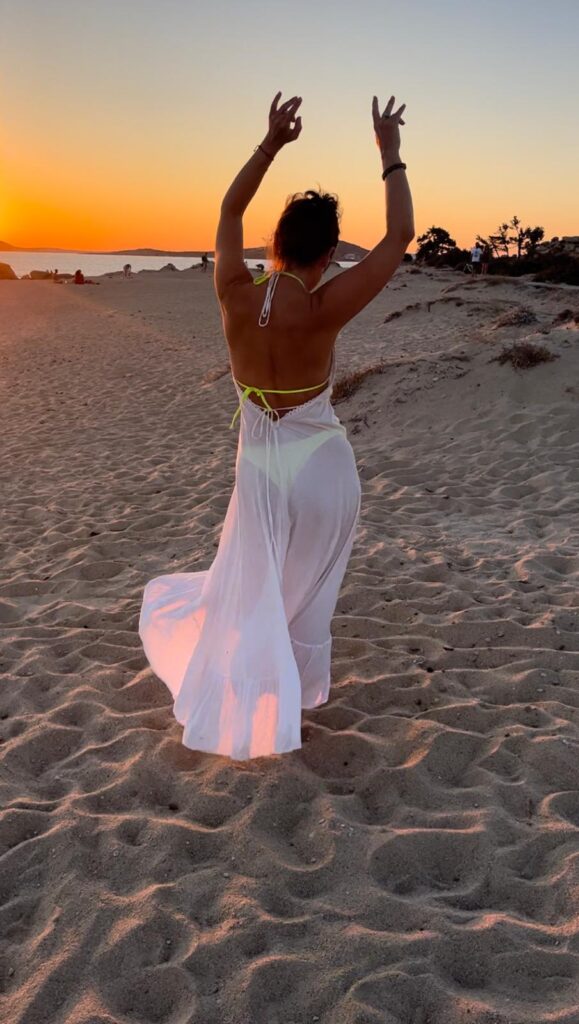
Ecstatic Dance is a conscious movement practice. It is a space where you are guided — through music and sometimes a short opening meditation — to feel your body and express whatever is there. Freely. Without thinking about it too much.
A typical session with me leading it starts with a brief explanation or guided meditation, followed by a dance session that can last anywhere from 45 minutes to two hours, and always ends with a short sharing circle where people can say a word or two about what came up for them.
But when you are doing it at home on your own — which is exactly what I encourage — it can be as simple as putting on one song and moving around your living room with your eyes closed. That counts. That is the practice.
What makes it ecstatic — and I want to be honest about this because the word “ecstatic” can sound intimidating — is what happens when you stop thinking and start feeling. When you leave your mind and enter your body, something opens up. You may start moving in ways that surprise you. You may feel emotions come up and pass through. You may feel a lightness, or a release, or just a quiet sense of having arrived somewhere real inside yourself.
That is the ecstatic part. Not performance. Not drama. Just the feeling of being genuinely alive in your own body.
Why This Matters So Much in Perimenopause
Perimenopause does something very specific to a woman’s relationship with her body. The changes — in weight, in skin, in energy, in the way your body feels from the inside — can make you want to disconnect. To stop paying attention. Hide or just to get through the day without thinking too much about any of it.
And on top of that, many women in perimenopause are also carrying years — sometimes decades — of stress, tension, trauma, unexpressed emotion, and unprocessed experiences in their bodies. Things that never had a place to go. Things that got pushed down because there was always something more pressing.
Ecstatic Dance gives all of that somewhere to go.
If nothing else this is a practice that releases stress and tension from woman’s body in the most natural way. It helps process, and move through, emotions that words cannot reach. It reconnects you with your sensuality — not in a sexual way necessarily, but in the sense of feeling alive in your senses, in your skin, in your physical self. And it strengthens your intuition, because the more connected you are to your body, the more clearly you can hear what it is telling you.
In perimenopause — when so much is shifting, when identity is reshaping, when the body is sending so many signals — this kind of embodied practice is not a luxury. It is, I would argue, one of the most important things you can do for yourself as a woman.
What Can You Expect It to Feel Like?
- At the very least: a good release of physical tension, a lighter body, and a clearer head. Like you have sweated something out that needed to go.
- Often: emotions coming up and moving through — sometimes tears, sometimes laughter, sometimes just a deep sense of relief. Nothing to worry about. This is the practice working.
- Sometimes: a genuine sense of joy and aliveness that you may not have felt in a long time. A feeling of being fully in your body and fully present in a way that is rare in daily life.
- At its best: what some people describe as an altered state — a sense of flow, of oneness, of complete presence. This is not common in a first session, but it is real and it does happen.
What Does It Actually Feel Like?
You do not need to aim for any of these. You just need to show up and move. Whatever happens is what was meant to happen that day.
And I want to say this clearly: you do not have to feel happy or joyful to do this practice. You can bring everything that is present in you — the stiffness, the grief, the anger, the exhaustion. All of it is welcome. Dance is a powerful alchemical practice. It helps transmute the energies within you, not suppress them.
A Dance with extremes — an act of radical honesty with yourself
However, it is possible for a woman to have naturally occurring spontaneous energy orgasms during free movement practice, because dancing can be like making love with life itself, with your own breath, through a sense of deep conscious union you have with your own body. This is more common once you start regular practice for extended periods of time, eg. 1-2h on a daily basis. It did happen to me many times and I know that it happens to other women too, but this is absolutely not the aim of ecstatic dance practice, just one of many things that can happen when you let go of thinking and let your body take over.
In the same way, whaling and crying to realise stored trauma, can also be a part of ecstatic dance practice, which happened to me many times too (many more times actually than ecstasy), because there was so much pain and grief and loss and loneliness that I became aware of when I started practicing regularly.
Most likely it will not happen to you when you start with one song a day, but please be prepared to meet yourself in a new, deeper way when you start making a space for your emotions and thoughts to be finally expressed without any censorship. That is why I encourage women I work with, to start practicing in the privacy of their own home.
I am also facilitating live sessions of Ecstatic Dance for women only (online or in-person) because I am committed to creating safe spaces for women to move and express freely, without any fear of judgement from men, or other women, who have no understanding what is the purpose and healing potential of ecstatic dance practice. I call these sessions — Sensual Ecstatic Dance (you can check here when the next one is happening)
Here Is How Some of the Women Felt
These are the words of women who have practiced with me — in group sessions, online, and in their own living rooms.

“Kamila, thank you for such an incredible ecstatic dance experience. Your open heart and beautiful guidance created a space that felt truly safe, feminine, and free. I was able to let go, reconnect with my body, and move without holding back — and I didn’t realise how much I needed that. It was ecstatic in every sense of the word — liberating, soulful, and deeply healing. I honestly wish more women knew how powerful and freeing this kind of movement can be. So grateful for you and the space you create.”— Liz, UK
“After the last Ecstatic Dance practice I feel like I’m ‘coming home’ — that energy starts to flow, I feel wrapped in the energy of the Universe, but trying to put these deep experiences into words is difficult for me. The experiences we can have during a Sensual Ecstatic Dance session are uniquely individual and profound. Everyone will find in that journey only as much as they carry inside — some may not even be able to get on that vehicle and set off, because they are not ready… but if they dare, the result can be transformative. In this practice, I believe you either FEEL — or you OBSERVE. For me, ecstatic dance is a space beyond words, where there is only feeling, a powerful primal energy, complete immersion, and the sense that I AM — nothing more. Thank you for the space you create and the journey you invite us into.”— Anna, Poland (translated from Polish)
“I really like dancing and I dance a lot, but I usually dance at parties where there is alcohol and chatting too, so 1 was a bit unsure to start with, because I never had to be silent and just pay attention to my body when dancing. My mind is usually busy, but in this practice my mind stopped, and I felt so present. So calm inside. It was such a welcome surprise. I really liked the dance and connecting with others in this way. I also liked the meditation we did at the beginning. I never tried meditation before. But my real favourite was the sharing at the end. I felt, I somehow knew these people, even tho we haven’t spoken a word until the end. After the practice we all went for a meal. It was great to make new friends and it was fun thing to do! I’m glad I tried it and I will definitely do it again.” — Athena, Greece
That was my very first cacao and ED session, so | was not quite sure what to expect, 1 am truly happy and grateful that | joined and I was open for new experiences in my life. Stepping into the space of this cacao ceremony and ecstatic dance session, I arrived feeling open, raw, and vulnerable. From the very first sip of the heart-opening cacao to the final moment of stillness, the experience was pure magic. The music, the energy, and the sacred atmosphere created the perfect setting for deep self-connection. As I surrendered to the rhythm, I felt layers of doubt and hesitation melt away. Every movement became an expression of trust, an affirmation that I am exactly where I need to be. By the end of the session, I felt whole-completely aligned, empowered, and deeply assured that I am on the right path. This experience was a reminder that true wisdom lies within, and when we allow ourselves to flow, everything falls into place. A must-experience for anyone looking to reconnect with themselves on a profound level. — Marianna, Germany
How to Start — Right Now, at Home, For Free
You do not need to attend a class, spend any money, or even leave your house to begin exploring Ecstatic Dance. Here is what I suggest:
Find a few minutes when you are alone. Put on a song — or use one of the free DJ sets that can be found online (I have listed some examples below, that I used myself). Close your eyes if that feels comfortable, or soften your gaze. Let your body start to move, however it wants to. Do not think about what it looks like. Do not direct it. Just follow wherever the movement wants to go and stay present to what you feel inside as you do.
That is the whole practice. Start with one song. Build from there. Once you are brave enough to make it longer, try one of these:
Free Ecstatic Dance sets you can use right now — from Soundcloud:
🎵 30 minutes — Winter Camp Mini Set
🎵 30 minutes — Ho’oponopono Journey
🎵 1.5 hours — great for a longer practice
A Few Practical Tips
A few simple things you can do, if you want to practice ecstatic dance at home. You do not need anything special. But these small things can make the experience feel safer, easier, and more natural — especially when you are just starting out.
- Have a water bottle nearby — depending on how deeply you move, you may want to pause and rehydrate.
- Wear something loose and comfortable — whatever lets you move freely. There is no dress code.
- Clear a small space — even just enough to stretch your arms out. You do not need a studio. Your living room is perfect.
- Start with your eyes closed, or soften your gaze downward. This helps you turn inward and stops you from thinking about what you look like.
- Let the music lead, but do not feel bound by it. If the music is fast and your body wants to move slowly — move slowly. Your inner experience is more important than the rhythm.
- Bring curiosity to whatever comes up. Thoughts, emotions, memories, impulses — all of it is welcome. You are not here to perform. You are here to feel.
- Stay conscious throughout. The intention is to connect with yourself, not escape. This is what makes it a practice rather than just exercise.
- Most of all — be playful. There is no wrong way to do this. And it is genuinely fun once you let yourself go.
Want to Practice With Me?
If you would like to experience Ecstatic Dance in a guided, supported space — I offer sessions both online and in person.
I run Sensual Ecstatic Dance sessions for women only, (and occasionally longer Ecstatic Dance events with cacao ceremonies that are open to everyone, men and women). The women-only sessions are held regularly and are a beautiful way to experience this practice in community — with other women who are on the same path of coming back to themselves.
👉 Click here to join the private WhatsApp group and hear about upcoming events
A Final Word

Perimenopause asks us to come back to our bodies at a time when our bodies feel most unfamiliar. That is not a coincidence. It is an invitation.
Ecstatic Dance is one of the most direct ways I know to answer that invitation. Not by fixing anything. Not by performing anything. Just by moving — freely, honestly, in whatever way your body needs in that moment.
I have been doing this for over five years. It still surprises me. It still moves me. And I have never once finished a session feeling worse than when I started.
That, for me, is enough of a recommendation.
Ready to go deeper than a solo dance in your living room? Ecstatic Dance is just one of the embodied practices we work through together inside the Finding Joy in Perimenopause Academy — Dr Kamila’s live cohort experience opening this October. If you’re ready to reconnect with your body, process what perimenopause is bringing up, and do it in community with other women, this is where that journey begins. Keep an eye on inherbody.co.uk for details as the doors open.
Visit inherbody.co.uk to find out more about my work. In Her Body is a platform for women going through perimenopause, or women who aren’t even sure yet if that’s what’s happening. Whatever stage you’re at, there is something here for you.
NOTE: These blogs articles are for information only. They often contain my personal experiences and opinions. They are not a substitute for medical advice. Please consult your GP or a qualified specialist about relevant assessment, medication, or hormone therapy.