Don’t have time to read now? Listen to the audio version (12 min).
Your Skin Is Drier. Your Hair Is Thinner. And the Beauty Industry Just Spotted You.
You catch yourself in the bathroom mirror and stop.
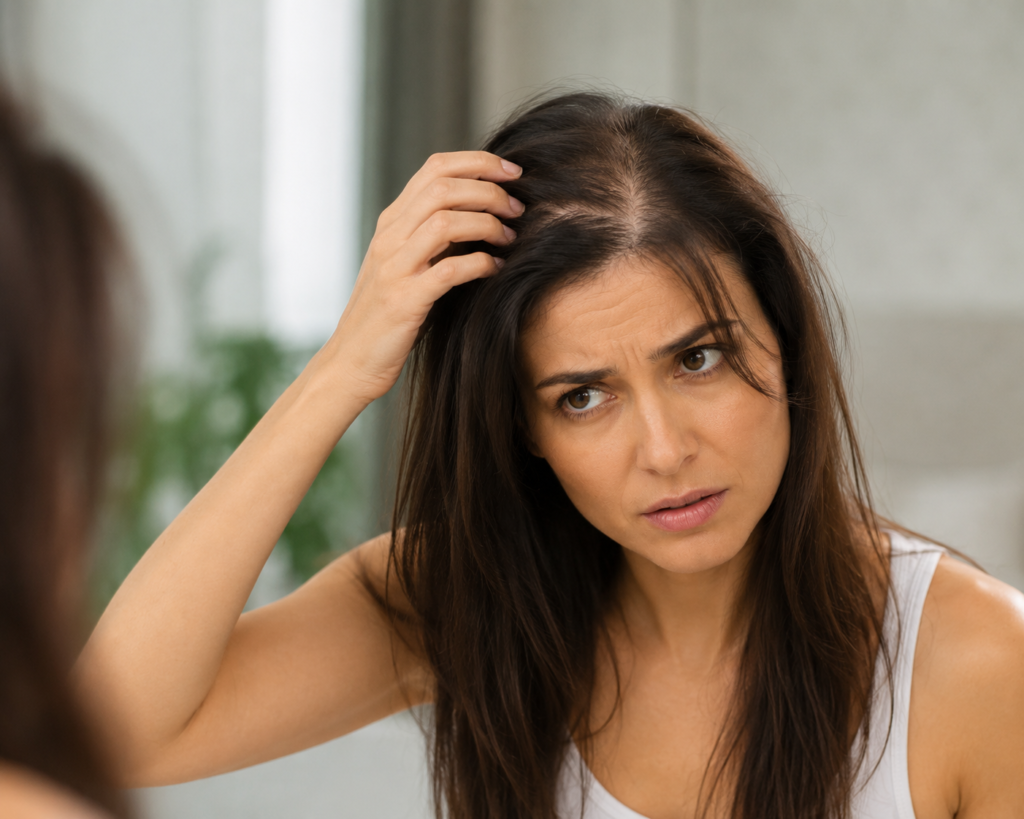
Your skin looks different. Drier, somehow. The texture around your eyes has changed overnight. Your hair — your hair that was always your thing — is coming out in the brush in a way it never used to. And somewhere underneath all of it is a feeling you haven’t quite let yourself name yet: you don’t look like yourself any more.
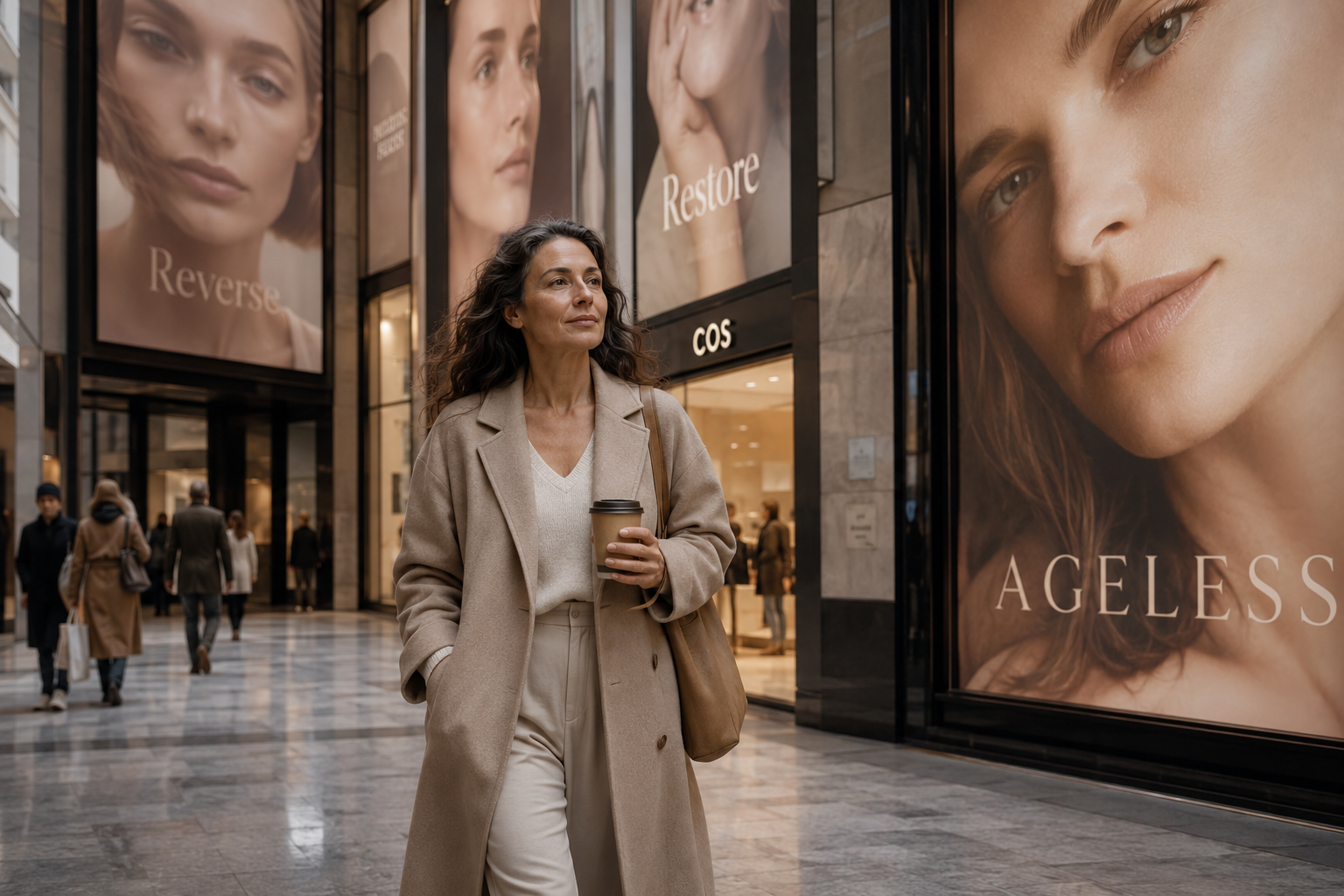
And then — before you’ve even had a cup of tea — an advert appears on your phone. A serum that will “reverse” these changes. A treatment that will “restore” what you’ve lost. An influencer in her 50s with immaculate skin telling you that perimenopause “doesn’t have to look like this.”
This blog is for you if any of that has landed recently. Because you deserve a clear picture of what is actually happening — and an honest conversation about who is profiting from you not having it.
What Is Actually Happening to Your Skin
Oestrogen does a lot of quiet, invisible work in the body. One of its jobs is supporting the skin’s ability to hold moisture, produce collagen, and maintain its thickness and elasticity. As oestrogen levels start to fluctuate in perimenopause — sometimes from one week to the next, not in a smooth decline — the skin starts to feel the difference.
What many women notice:
- Dryness that doesn’t respond to the moisturisers that used to work
- Texture changes — a roughness or crepe-like quality that feels sudden
- Skin that seems thinner, more fragile, more reactive
- Fine lines deepening, or appearing in places they weren’t before
- Breakouts returning — often on the jaw or chin — because shifting hormones affect sebum production
- Itchy skin, sometimes across the whole body (including, oddly, inside the ears)
- Loss of elasticity — everything feels like it’s sagging. As if your skin detached from the bones and muscles underneath and is no longer staying in place when you are upside down or on your side. And this refers not just to your face, but also to your belly and arms.
These are real, biological changes. Most of them are driven by declining oestrogen and the effect it has on collagen production and the skin’s moisture-retention mechanisms. They are not a failure of your skincare routine. They are not because you haven’t been taking care of yourself.
They are perimenopause. And they were always going to arrive.
What Is Happening to Your Hair
Hair thinning in perimenopause is extremely common — and extremely under-talked about. Many women describe it as one of the most distressing changes, partly because it is so visible, and partly because it feels so personal. Hair is tied up with identity in a way that hot flushes, for instance, are not.
What tends to happen: oestrogen supports the hair follicle’s growth cycle. As it fluctuates, hair can grow more slowly and shed more quickly, so what you have at any given time starts to thin. The hair that does grow may be finer and more prone to breakage. Some women notice their hairline changing slightly, or their parting looking wider.
Then there is the grey. For some women, going grey happens gradually over many years and feels like a quiet, natural shift. For others, perimenopause seems to accelerate it — a sudden proliferation of silver at the temples, or a change in texture as grey hairs grow in coarser and more wiry than what came before.
The emotional weight of going grey is worth naming separately, because it is different to thinning. Thinning is something you notice privately, in the brush or in certain light. Grey is visible to the world. And the world — or at least the industry that profits from your appearance — has a very loud opinion about it. Women are told, in a hundred different ways, that grey hair ages them. That it signals decline. That it should be coloured, covered, managed. The market for hair dye specifically targeting perimenopause-aged women is not subtle about this.
What I will say is this: whether you colour your hair or embrace the grey is entirely your choice, and both are valid. What is not valid is the idea that grey hair makes you less — less attractive, less relevant, less yourself. That is not a biological fact. It is a marketing position. And you are allowed to disagree with it.
A few things that can make this worse are worth knowing about:
- Iron deficiency — very common in women in their 40s, and an overlooked driver of hair loss
- Thyroid imbalance — also common, and frequently triggered or unmasked by perimenopause
- High stress and disrupted sleep — both of which affect the hair cycle
- Extreme dietary restriction — the body deprioritises hair when it is under-resourced
If your hair loss feels significant or sudden, it is worth asking your GP for a blood panel that includes iron, ferritin and thyroid function. This is not catastrophising — it is good information to have, because some of these causes are treatable independently of perimenopause itself.
The Feeling Underneath the Changes

This part matters, and I want to sit with it for a moment.
A lot of women describe the skin and hair changes of perimenopause not just as physical symptoms but as a kind of grief. You look in the mirror and you don’t see yourself. You feel less attractive. Less visible. Like something that defined how you moved through the world has quietly departed.
This grief is real and it deserves to be named, not rushed past. But I also want to offer something to set beside it: the version of attractiveness that perimenopause is disrupting is a very specific and very constructed one. Smooth skin. Full, shiny hair. A face that shows as few years as possible. We have been sold this picture for so long that we have begun to believe it is simply what women are supposed to look like.
It isn’t. It is a market.
The Industry That Found You
Brands have identified women in perimenopause as a significant commercial opportunity — because we are at the height of our earning potential and deeply primed to spend money on something that makes us feel less like we are losing ground. The skincare market has grown considerably in the last 10 years, along with the explosion of social media use. But that growth is not accidental.
The products themselves are not always dishonest. Some of the ingredients used in perimenopause skincare — ceramides, hyaluronic acid, retinoids — do support skin barrier function and are genuinely worth knowing about. This is not a blanket warning against skincare.
But the framing around those products often is dishonest. The language of “restore,” “reverse,” “defeat the signs of ageing,” “look like yourself again” — all of it starts from the premise that what is happening to you is a problem to be corrected. That you had something, and now you are losing it, and the right product can stop that loss.
What that framing rarely tells you:
- No topical product replaces the function of oestrogen in skin tissue
- The most significant thing you can do for your skin and hair in perimenopause involves sleep, nutrition, stress and HRT
- Many of the procedures being marketed to perimenopausal women work temporarily, are expensive, and address the surface rather than the source
- The feeling of “looking less like yourself” is partly hormonal, partly grief, and partly the result of decades of being told that younger-looking skin is more valuable skin
“The beauty industry did not create perimenopause. But it has built an entire business model around making sure you feel inadequate because of it.”
What Actually Helps

I am not going to tell you to stop caring about your skin or hair. Caring about how you look is not vanity. It is human.
But I would like to redirect some of the energy and money that tends to flow toward products, and point it at things that genuinely move the needle.
01. Sleep
Sleep is when the body repairs and restores. Disrupted sleep — which is one of the most common symptoms of perimenopause — accelerates the visible signs of skin ageing faster than almost anything else. Addressing your sleep is addressing your skin.
02. Nutrition
Protein is the building block of both collagen and hair. Many women in midlife are eating less protein than they need, without realising it. Omega-3 fats, zinc, iron and B vitamins also play direct roles in skin and hair health. Your body cannot produce collagen without vitamin C. If you are constantly dehydrated (or under-hydrated) no moisturiser in the world is going to restore the moisture in your face. Before you buy another serum, look at your plate.
03. Stress
Chronic stress raises cortisol, which breaks down collagen and disrupts the hair growth cycle. This is not a metaphor. Stress is a physiological event with direct consequences for how your skin and hair behave. Managing your load is not a luxury — it is a health strategy.
04. HRT — for those who are candidates
Many women report noticeable improvements in skin hydration, elasticity and hair thickness when they start HRT. This makes sense: if fluctuating oestrogen is driving the changes, then steadying oestrogen will help. HRT is not right for everyone, and it is a decision to make with a practitioner who has the full picture of your health. But it is worth knowing that it exists as an option, and that the skin and hair benefits are real for many women. In my personal experince, estriol cream on your face can do more magic than the most expensive cream out there.
05. A sustainable skincare routine
Yes, routine skincare has a place. Gentle cleansing, barrier-supporting moisturiser, sun protection, plenty of Vitamin C, copper peptides and — if your skin tolerates it — a retinoid. These genuinely support skin health. They work best as part of the wider picture above, not instead of it.
A Different Mirror

Here is what I have come to believe, after twenty-five years of working with women and going through this transition myself.
The skin and hair changes of perimenopause are real.
They can be supported, slowed, and in some cases significantly improved. But they cannot be — and should not need to be — erased.
We are aging and evolving into new versions of ourselves.
Our faces reflect the changes we have been through and the wisdom we have gained from them.
The women I have worked with, who navigate this time with the most grace, are not the ones who stopped fighting it long enough to ask different questions.
Not: “what can I do to look like I used to?” but
- “how can I be happy with who I am becoming?” And
- ”how can I feel confident and attractive from the inside out”?
If you know what will make you feel more confident, do that of course, but do it for yourself and not because society expects you to look a certain way.
The most attractive woman is the one feeling at home in her own body.
Loving yourself the way you are — not for the looks, but for who you are and what you bring to the world — gives you glow and radiance that is uncomparable with anything the beauty industry can offer.
If you have questions about what is happening in your body — whether it’s skin, hair, hormones, mood, or simply something that feels different and you’re not sure what it means — come to my free monthly Q&A. It’s an open space where you can ask me anything related to perimenopause and what you’re going through. No question is too small, and nothing is off limits.
Every third Wednesday, online. No commitment. Just bring your questions.
→ Join the free Q&A at inherbody.co.uk