
Don’t have time to read now? Listen to the audio version (13 min).
Why Women Need Other Women in Perimenopause
The Healing Power of Sisterhood — and Why Talking It Out Is Not a Weakness, but Medicine
When was the last time you really talked to another woman? Not the quick “how are you — fine, busy!” at the school gate or in the office corridor. I mean really talked. Sat down, unrushed, and said out loud what is actually going on in your life and in your body — to someone who simply listened.
If you have to think hard about the answer, you are not alone.
For so many women in their 40s and 50s, those conversations have quietly disappeared — and later in this blog I will explain exactly why, because the reason is not what you think, and it is certainly not that you stopped caring.
And the painful irony is, that is happening at exactly the stage of life when we need each other the most.
In this blog, I want to explain why connection with other women is not a nice-to-have, not a luxury, and certainly not an indulgence. For a woman in perimenopause, it is one of the most powerful — and most overlooked — forms of support there is. And I want to show you why, including a little science that I find genuinely beautiful.
Women Don’t Deal With Stress the Way Men Do
Let me start with something that explains so much — about you, your friendships, and possibly your relationship too.
For decades, we were told that humans respond to stress in one way: fight or flight. Face the threat, or run from it. But that picture was built largely on studies of men. When researchers finally began studying women properly, they noticed something different. Under stress, women have a strong additional response — Shelley Taylor’s research at UCLA have called it “tend and befriend”.
When life gets hard, our instinct is to draw closer. To tend to the people we love, and to reach for other women. To sit down together and talk. Or just express how we feel. We do not need solutions at this stage. Being listened to is enough.
Here is the part I love. When women talk about what is stressing them — truly talk, and feel heard — the body responds. Connection and feeling understood are soothing to a woman’s nervous system in a very real, physical way. The bonding hormone oxytocin rises, and the stress response begins to settle. The conversation itself is the medicine.
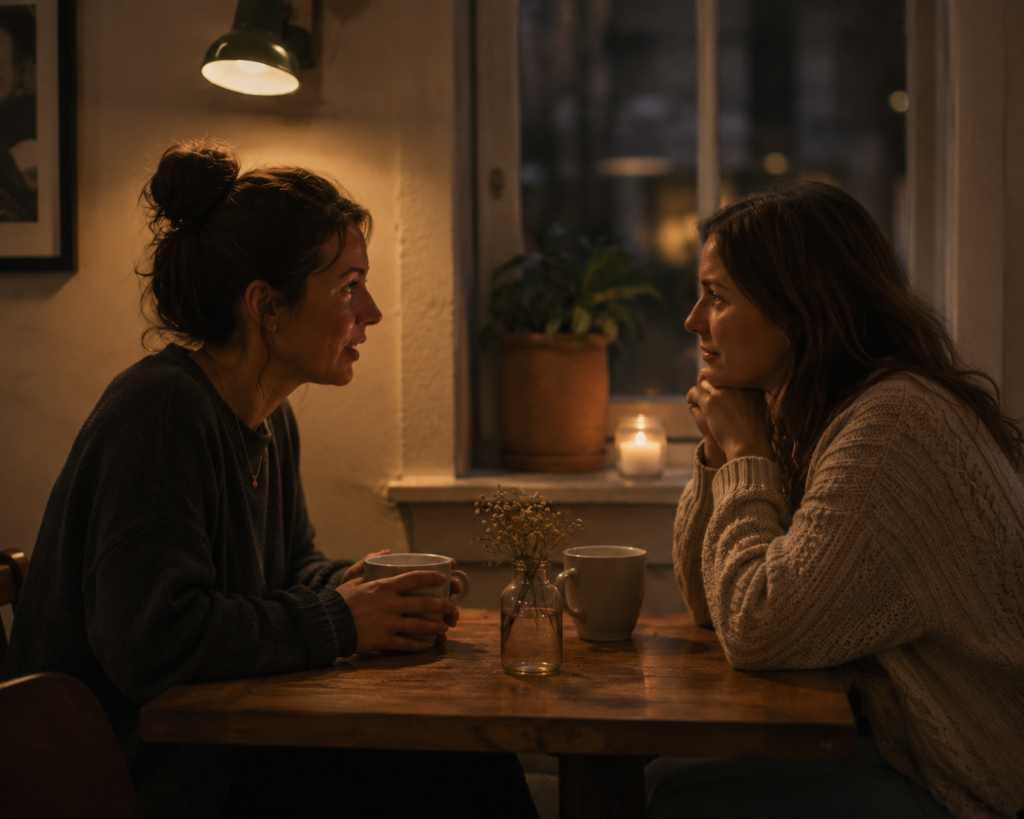
This is why a long talk with a good friend can leave you feeling lighter even though nothing about your situation has changed. Nothing was fixed. No solution was found. And yet you feel better — because for women, that is how stress is processed. Not by solving. But by sharing. As the classic proverb explains: Problem shared is problem halved.
So Why Do We Stop Sharing in Perimenopause?
Now, you might be thinking: if reaching for other women is my instinct, why don’t I do it any more?
Here is the cruel trick of modern life. The instinct is still there — but everything around us overrides it. When stress rises, our diaries fill, and something has to give. And what gives is never the job, never the children, never the household. It is often that coffee with a friend. The phone call. The walk. The very thing our biology is asking for, is the first thing we cross off the list — because it looks optional, and everything else looks essential.
So the more stressed we become, the less we connect. And the less we connect, the worse the stress feels. It is a quiet downward spiral — and most of us are in it without ever noticing. Not because our instinct disappeared. Because we were taught to treat it as a luxury.
“But Talking Doesn’t Solve Anything”
If you have ever opened your heart to your partner about something difficult and received a list of solutions in return, you know this clash well. He thinks he is helping — and in his way, he is. Many men process stress by fixing the problem or by withdrawing to deal with it alone.
But as a woman, most often you don’t want a solution. You want to be heard. And there is nothing wrong with that — it is not neediness, and it is not going in circles. It is your nervous system doing exactly what it was designed to do: regulating itself through connection. For us women discussing the difficulties lightens the emotional load we carry.
So please let go of any idea that talking things out without solving them is a waste of time. For women, being witnessed in how we feel, is not the opposite of coping. It is how we cope.
The Disappearing Village
Now let me name something tender.
For most of human history, women lived surrounded by other women. We raised children together, cooked together, worked side by side, and moved through every stage of life (including perimenopause, even though it was not referred to as such) — in the company of mothers, sisters, aunts, neighbours and friends. Older women who had already crossed the threshold of menopause were right there, visible, showing the younger ones what was coming.
That village is largely gone. Today, a woman in her 40s often carries a household, a career and a family essentially alone — frequently as the one holding all the invisible threads. And the older women who could have prepared her for perimenopause? Many of them were raised in a culture of silence and never spoke about it at all.
So we arrive at the most destabilising transition of our adult lives — isolated, uninformed, and convinced that whatever is happening to us is happening only to us. So in a culture of not showing weakness and toughening it out, we are embarrassed to share or show any vulnerability.
Why This Matters Even More in Perimenopause
Everything I have described so far is true for women at any age. But in perimenopause, the stakes quietly rise. Here is why.
Loneliness is a stress on the body — and stress drives symptoms. Chronic stress keeps cortisol, our main stress hormone, elevated. And as I have written about before, the body makes cortisol and our sex hormones from the same raw material — so the more your body spends on stress, the less it has left for hormonal balance. Isolation doesn’t just feel bad. It feeds the very symptoms that are making this transition harder. Studies (on both, men and women) equate the physiological impact of chronic loneliness to smoking up to 15 cigarettes a day, elevating risks for heart disease, stroke, and premature death. The World Health Organization (WHO) even categorizes it as a leading global health threat.
Connection is the antidote your biology asked for. If talking with other women settles a woman’s nervous system, then sisterhood is not a “soft extra” on top of the “real” work of nutrition, sleep and hormones. It belongs on the same list. A good, honest conversation is a form of hormonal support.
Perimenopause thrives in silence — and breaks open when shared. Almost every woman I work with believed, at first, that she was the only one. The only one waking at 3am. The only one forgetting words mid-sentence. The only one feeling rage, or grief, or like a stranger in her own body. Until the moment she heard another woman say “me too” — This is a precious moment. Something changes. The shame dissolves. The fear softens. What felt like a private malfunction turns out to be a shared right of passage.
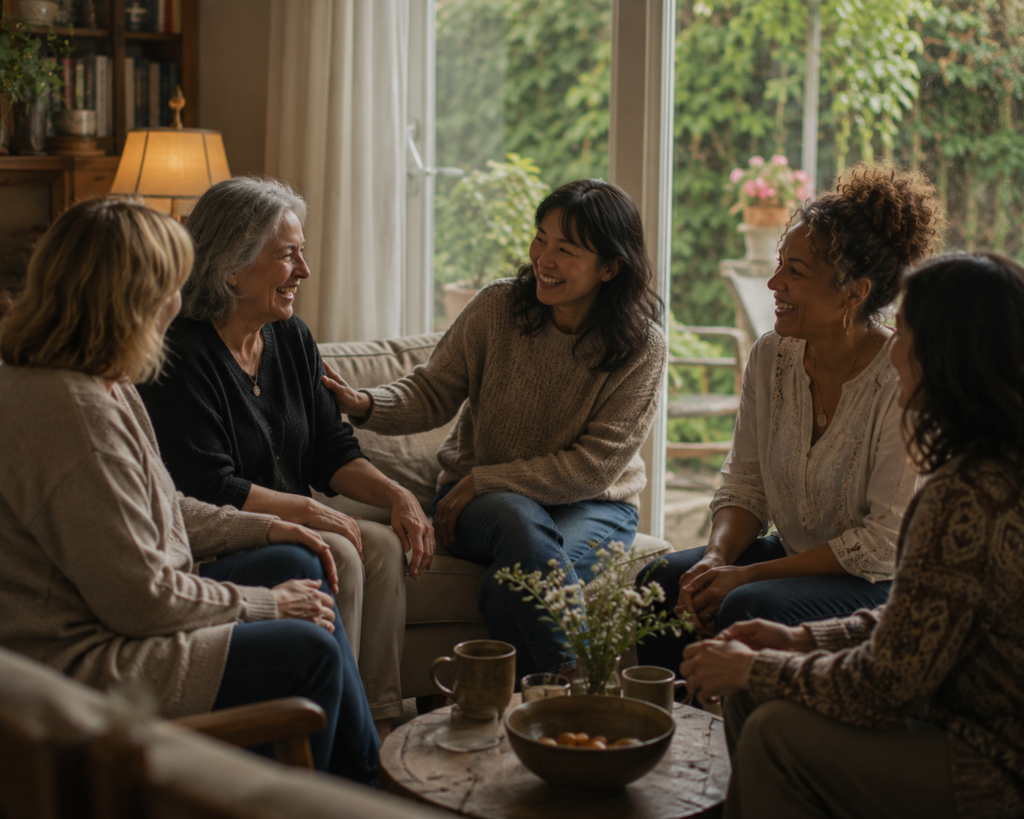
Other women hold the map. A woman a few steps ahead of you on this path can tell you what helped her, which doctor finally listened, what she wishes she had known before. This is the wisdom the village used to pass down — and we can rebuild it, deliberately, today. In some small way this was my intention behind building In Her Body Platform.
What Sisterhood Actually Looks Like
When I say sisterhood, I don’t mean anything grand. I am not asking you to find ten new best friends or join a commune. Real sisterhood is much simpler — and already much closer than you think, e.g.:
- Having one honest conversation instead of three polite ones, because depth matters far more than frequency.
- Being listened to without being fixed — and offering the same in return. Try asking a friend: “Do you want comfort or solutions?” It changes everything.
- Saying the unsaid thing first. Vulnerability is contagious in the best way — the moment one woman speaks honestly about her perimenopause struggles or questions, every other woman in the room exhales.
- Spending time with women who are going through the same transition — because there are things only they can fully understand. Only a woman who has never experienced debilitating brain fog or an embarrassing hot flash will be the one asking: why don’t you let nature do its job (!?)
- And sometimes, simply sitting together. Walking together. Laughing together. Or dancing together is as much as we need. Not every connection needs words.
A Few Gentle Ways to Begin
If your friendships have thinned out over the years, please don’t judge yourself — and please don’t believe it is too late now. Connection can be rebuilt at any age. Here are some small ways to begin:
- Reach out to one woman this week. Not a group — one. A message that says: “I’ve been thinking of you. Shall we walk and talk properly?”
- When she asks how you are, answer honestly. Go first. Watch what happens.
- Make it regular. A monthly walk, a standing phone call — connection grows from rhythm, not grand gestures.
- And if there is no one in your life right now who understands this transition — borrow a village. Join a women’s circle, a group, a community of women in the same chapter. Walking in as a stranger takes courage, but you will not be a stranger for long. “Me too” works just as well among new faces.
You Were Never Meant to Do This Alone
If you take one thing from this blog, let it be this: the loneliness you may be feeling in perimenopause is not a personal failing. It is the predictable result of a world that took away the village and then told women to cope quietly.
Your instinct to reach for other women — to talk it out, to be heard, to sit in good company — is not weakness, and it is not avoiding the “real” work. It is the real work. It is ancient, it is wise, and it is written into your biology.
So tend. Befriend. Talk — even when talking solves nothing, or especially when talking solves nothing. Because you were never meant to cross this threshold alone. None of us were.
If You Are Looking for Your Village
If You Are Looking for Your Village
This is exactly why community sits at the heart of everything I do at In Her Body Platform. My free monthly Q&A is a place where women ask what they have been carrying quietly — and discover they are not the only ones. It runs on the 3rd Wednesday of every month, online, and every woman is welcome — you don’t even need to be in perimenopause yet.
If you want to go deeper and fully understand what is happening in your body, your mind, and your
sense of self — join my Finding Joy in Perimenopause Programme, a guided group journey
through this transition with other women who understand exactly what you’re navigating.
🔗 Join the 9-Week Programme
And if you want the most personalised support — 1:1 Exclusive Mentoring allows us to
build a picture of exactly where you are and what is available to you, personally, at this stage.
🔗 Find Out More About 1:1 Work with Dr Kamila
Email: hello@drkamilahortynska.com
Instagram: @dr.kamilahortynska
Additionally, you may want to join my private WhatsApp group related to Free Q&A sessions, where I share updates about upcoming events, free resources and things that women in perimenopause may find useful.
“I joined for the information. I stayed for the women. I had no idea how much I needed to be in that room (even a virtual one) with other women who were going through exactly this. Real conversation about something we’d all been carrying quietly for years. Kamila creates that safety. The knowledge she gives you is extraordinary, but the feeling of not being alone in this? That was the thing I didn’t know I needed most”. Natalie, 48