
Don’t have time to read now? Listen to the audio version (12 min).
Your Period Was Your Compass — And the Grief Nobody Talks About When It Starts to Fade
There is a particular kind of confusion that comes with perimenopause that I don’t think gets talked about honestly enough.
It’s not the hot flushes. It’s not the sleepless nights. Those are hard, and they are real — but at least they have names. At least when you search for them, something comes up. At least someone has told you they are coming.
The confusion I’m talking about is quieter than that. It’s the feeling of reaching for something familiar — your cycle, your rhythm, the monthly pattern your body has kept for twenty, thirty or if you are lucky for forty years — and finding that it’s no longer where it used to be.
Your period comes three weeks late. Or two weeks early. Or it’s so light you barely notice it. Or it arrives with a ferocity you haven’t known since your twenties. Or one month, it simply doesn’t come at all.
And you don’t know what to do with that.
Not just practically — though the practical uncertainty is real too. But emotionally. Something has shifted, and nobody prepared you for how that would feel.
Nobody tells you that losing the rhythm of your cycle can feel like losing a part of yourself.
Your cycle was your reference point
Most of us don’t think consciously about how much we rely on our cycle. It’s just there — month after month, year after year. A background rhythm that organises time in a particular way.
It tells you where you are. Not just in the month, but in yourself. The week you feel sharp and energetic and want to be around people. The week you feel quieter, more inward, more sensitive. The days before your period when you might cry at something small and know — oh, it’s ok. I’m close, that’s why. The arrival of your period itself, for many women brings a kind of reset. A release. A sense of beginning again.
That rhythm is woven into your life in ways you may never have consciously noticed. And when it starts to become unreliable — when it stops being something you can count on — you lose your reference point.
Not just for your body. For yourself.
This is what I want to talk about today. Not the hormones, not the medical side — there is a time and place for that and I have written a lot on that already .
But the emotional reality of what it feels like when your cycle starts to disappear. Because that reality is rarely spoken about. And the silence around it leaves too many women feeling confused, untethered, and alone.
The disorientation of not knowing where you are

When your cycle becomes irregular, one of the first things you lose is the ability to explain yourself to yourself.
What I mean by that is this: your cycle gave you a framework. When you felt suddenly tearful, you could say — I’m premenstrual. When you felt unusually anxious or flat, you could look at where you were in your cycle and find a reason. When you felt low or extra tired, there was often a hormonal context to make sense of it.
That framework disappears in perimenopause. The mood shifts still come — sometimes more intensely than before. But now there is no map. No way to locate yourself. No answer to the question: why do I feel like this today?
And so the questioning starts.
Is this depression? Is this anxiety? Is this just who I am now? Am I losing my mind?
I hear this from women constantly. And it breaks my heart a little every time, because the answer is: No — you are not losing your mind. You are losing your map. And that is a very different thing, but if no one is telling you that, it is almost impossible to know the difference. So you sit with that disorientation, quietly wondering what is wrong with you. Carrying it alone. Not even sure how to name it.
You are not losing your mind. You are losing your map. And that is a very different thing.
The grief that doesn’t have a name
Grief is what we feel when we lose something that mattered to us. Something whose presence shaped our life in ways we only fully understand once it is gone. So I want to use the word grief here deliberately. Because I think it is the right word, even though it is rarely used in this context.

For many women, the loss of a regular cycle in perimenopause is exactly that kind of loss. Even if your periods were painful. Even if you never particularly liked them. Even if you have spent years wishing they would just stop.
Because it is not the period itself you are grieving. It is what it represented.
If nothing else, you are losing the rhythm. The predictability. The sense of your body doing something it has always done, reliably, on schedule.
It is, for some women, a loss of fertility — even if they never wanted more children, or any children in fact. The ending of that possibility, (however theoretical it had become), is still an ending.
It is a chapter of your life. A long one. One that started when you were a girl and carried you through decades of your adult life. And now it is closing, not with a clear ending but with a slow, irregular fade — which is its own particular kind of hard.
There is no ceremony for this. No ritual that marks the transition. In many cultures, there once was. But in the world most of us live in now, this happens quietly, privately, often without anyone around us even knowing it is happening.
And because there is no ceremony, there is often no permission to grieve. Women tell me they feel silly for being sad about their periods ending. They expect themselves to feel relieved, or indifferent, or simply practical about it. And when they don’t — when grief arrives instead — they don’t know what to do with it.
There is no ceremony for this loss. No ritual, no marker. Just the slow, quiet realisation that something is ending — and you were never given permission to grieve it.
Other kinds of grief that can arrive with this

Grief rarely arrives alone. It tends to bring other things with it — and some of them can come out of nowhere.
For some women, it is the question Am I ready for this? — arriving before they have ever consciously thought about it. Many single women have prioritised their careers, sometimes out of genuine passion, sometimes to fill a quieter loneliness, and for years have barely noticed time passing. A missed period can change that in an instant.
For women having their first child in their 40s, or considering another, an irregular cycle can bring a sharp mixture of time pressure and regret. For some, it is the first time they have to face the possibility of never having children. Of not having a family after all. And if they are still looking for a life partner, this can be even more painful to sit with.
For others, it stirs panic or self-criticism — a sense of having wasted time on things that don’t seem to matter, of not having achieved enough yet. The comparisons and judgements can be relentless.
It can also open up questions of identity. Who am I, if not a woman in the way I have always understood that word? What does it mean to be moving out of the fertile years, into whatever comes next? These are not small questions. They touch something very deep in how many of us understand ourselves. For some women, they lead somewhere unexpected — a realisation that they don’t want to subscribe to the idea that fertility equals femininity, and an invitation to explore other ways of expressing themselves and their natural creative force.
For other women, it brings a grief that is older than this moment. A sadness about choices not made, or a body they never quite made peace with. The irregularity of the cycle can become a kind of doorway, opening onto a new level of awareness — something that has been waiting for a long time.
And sometimes it is simply the grief of change itself. Maybe you are fit, happy with your life, and have had no perimenopausal symptoms at all — then the first missed period takes you by surprise. It forces you to realise that you, too, will go through menopause. That you, too, are getting older. That things are changing, even if nothing else shows it yet.
It’s often not dramatic. Most of it is very quiet. But it is real. And it deserves to be taken seriously — not managed, not medicated away, not explained with a hormone chart.It deserves to be listened to.
What actually helps

The most important thing I can tell you is this: naming it helps.
The moment you can say — I am grieving something. This loss is real. This confusion is real. I am allowed to feel this — something shifts. Not the symptoms, not the hormones, not the situation. But your relationship to it.
You move from fighting it to moving through it. And that is everything.
So please let go of any idea that talking things out without solving them is a waste of time. For women, being witnessed in how we feel, is not the opposite of coping. It is how we cope.
Beyond that, a few things I have seen make a real difference:
- Talking to other women who are in it. Not to compare symptoms or seek reassurance, but simply to be with people who understand. The isolation of perimenopause — the sense that this is happening to you privately, invisibly — is one of the hardest parts. Connection breaks that.
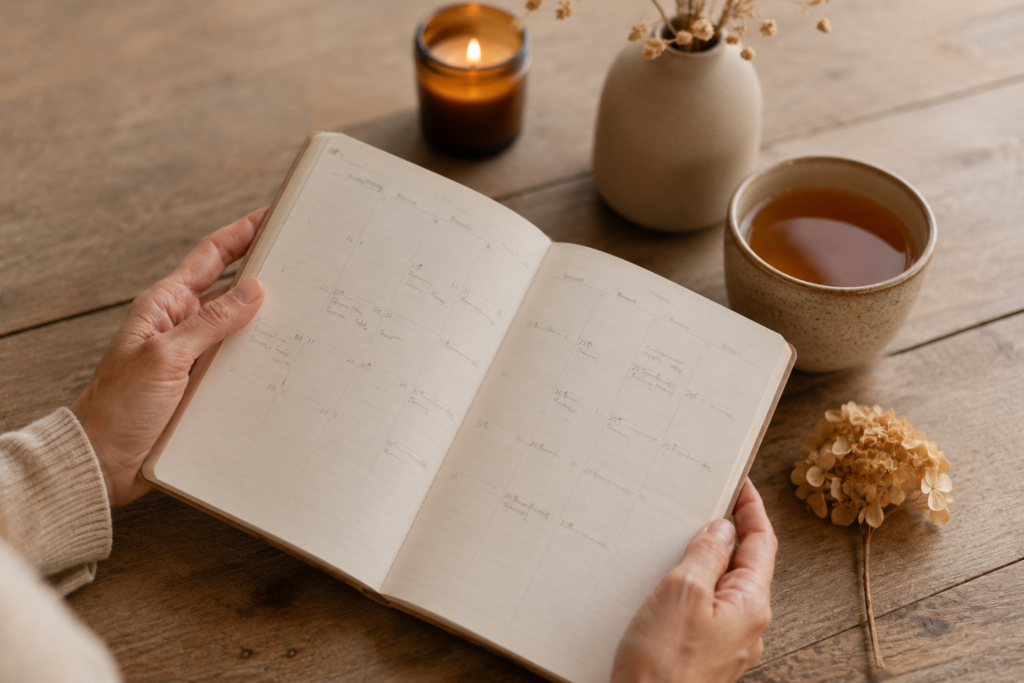
- Tracking what you can. Even when your cycle is unpredictable, your mood and energy often still follow patterns — just less obvious ones. Keeping a simple journal, even for a few weeks, can begin to give you back a sense of your own rhythms.
- Giving yourself permission to not be fine. Perimenopause asks a lot from us women. It is a profound transition — biologically, emotionally, psychologically and spiritually. You do not need to manage it tidily. You are allowed to find it hard.
- Getting informed. Understanding what is happening in your body — even in broad terms — can take the edge off the fear. Not because knowledge fixes the grief, but because it means you are no longer confused about what you are grieving.
Perimenopause is not just a hormonal event. It is a life transition. And like all transitions, it involves loss — even when it also involves possibility of gains.
The loss of your cycle’s regularity is a real loss. The disorientation that comes with it is real. The grief is real.
You are not making it up. You are not being dramatic. You are going through something significant — and you deserve support that treats it that way.

You Don’t Have to Navigate This Alone
Every month I hold a free Ask Dr Kamila Q&A — a space where you can ask the questions you can’t always ask your GP. If what I’ve written here resonates with you, come along. Or if you know a woman who may need to be there, send it to her.
If you want to go deeper and fully understand what is happening in your body, your mind, and your
sense of self, join my Finding Joy in Perimenopause Programme.
🔗 Join the 9-Week Programme
And if you are looking for the most personalised support, I also offer 1:1 perimenopausal mentoring. If you are interested, you can learn more there.